Executive Summary
Executive Summary
LevelCPPE Hospital Operational Continuity Preparedness Model
Hospitals are the first receivers during regional contamination incidents. Patients will arrive regardless of the hospital's preparedness.
Our goal is to help your hospital remain open, support controlled reception of potentially contaminated arrivals, and support controlled reception, screening, routing, decontamination-support workflows, and care coordination for potentially contaminated arrivals during the first 72 hours.
The determining factor is not the existence of a written emergency plan.
The determining factor is the hospital's operational capability to protect First Receivers and support controlled reception, screening, routing, decontamination, and care coordination for potentially contaminated arrivals within 100 miles during the first 72 hours of a contamination event.
The LevelCPPE Hospital ED Continuity Preparedness Model -
Tier-3 and Tier-4 model Push Packs for hospital preparedness to keep the ED open and support controlled reception, screening, routing, decontamination, and care coordination for potentially contaminated arrivals during the first 72 hours. See: Tier-3 & 4 Push Packs configured to receive potentially contaminated patients without contaminating the Emergency Department and Hospital Units, the hospital's first receivers for over 72 hours.
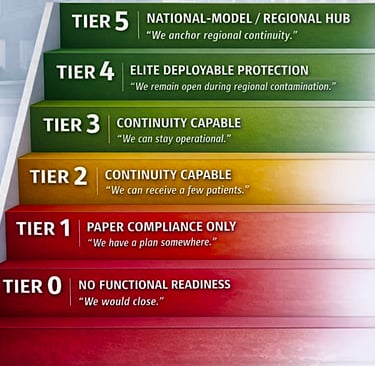
Most hospitals operate between Tier 1 and Tier 2, where plans exist, but operational protection for staff and first-receiver departments remains limited.
LevelCPPE helps hospitals achieve Tier 3 and Tier 4 readiness by protecting essential first-receiver departments, enabling leadership to issue coordinated response orders, and allowing the hospital to maintain operations while supporting controlled reception, screening, routing, decontamination-support workflows, and care coordination for potentially contaminated arrivals during the first 72 hours.
Achieving this level of readiness requires three operational capabilities.
Executive decision continuity
Leadership must have a structured response framework to coordinate actions during the first hours of an incident.
Protected personnel
Essential staff must have deployable respiratory and protective equipment capable of sustained operations.
Operational endurance
Hospitals continue to provide core services even if external help gets delayed.
Each configuration includes full-barrier Level-C protective equipment, powered air-purifying respirators, personal radiation alerting devices, and survey instruments to improve situational awareness and decision support.
Area Gamma Alarms and Personal Radiation Alerts for First Receivers promote As Low As Reasonably Achievable - ALARA Guidelines.
The system is based on a NIOSH-approved powered air-purifying respirator platform. This platform reduces breathing resistance and fatigue, enabling extended operational use during high-stress response conditions.
The pairing of the PAPR Headgear and the PAPR Unit have an
Assigned Protection Factor of APF-1000. OSHA's highest Level-C PAPR rating for particulates/powders. The Fallout PAPR.
When combined with the Tier-3 EM Executive Checklist
The Level-C PPE Push Pack becomes more than stored protective equipment.
It becomes a reviewable continuity-support system that helps leadership plan for First Receiver protection, controlled reception of potentially contaminated arrivals, radiation screening, and ED continuity during the first 72 hours of a regional contamination event.
Hospitals implementing the LevelCPPE model strengthen their ability to maintain business operations, protect staff, and support controlled reception of potentially contaminated arrivals during the most unstable phase of a regional emergency.
Hospitals that attain Tier-3 contamination preparedness have:
The correct Level-C PPE with PAPR, radiation alerts, deployable decontamination units, backup communications, and a
3-day self-sufficient Shelter Kit.
Structured to support hospital review against Joint Commission Emergency Management standards, CMS Emergency Preparedness requirements,
ASPR HPP capabilities, and FEMA AEL functional categories, where applicable. LEVELCPPE does not determine, certify, or guarantee compliance.
Call and review your current EOP CBRN Response Strategy.
LevelCPPE.com
Free CBRN Response Consultation for Hospital Emergency Management.
727-580-5997
Doug@LevelCPPE.com
-------------------------------------------------------------------------------------------------
Here is a small example of the
Tier-3 Executive EM Response Checklist Template.
Intended for Hospital Executive Officers during the
first 72 hours of a CBRN Contamination Event within 100 miles.
Note: The activation of the Tier-3 ED Continuity Push Pack happens separately. The First Receivers may be self-sufficient for 72+ hours.
Your Tier-3 ED Continuity CBRN Push Pack includes a
custom 111-item CBRN Response Checklist Template.
The hospital executive officers complete the hourly functions
to modify processes, limit chaos, and speed recovery.
Perfect for Hospital CEO, Finance CFO, Operations COO,
Information CIO and Media CMO.
Phase 1: Immediate Response (0-2 Hours)
CEO: Activate crisis management, establish command, and coordinate with authorities.
CFO: Release emergency funds, implement protocols, and assess initial impacts.
COO: Secure systems, define containment, and initiate evacuation.
CIO: Enable emergency IT systems, protect data, and establish remote command.
CMO: Initiate crisis communications, notify stakeholders, and issue public updates.
Phase 2: Extended Response (2-24 Hours)
CEO: Maintain organizational unity, brief stakeholders, and review continuity plans.
CFO: Conduct financial analyses, secure additional funding, and track costs.
COO: Oversee decontamination, resource deployment, and assess facility integrity.
CIO: Maintain backups, monitor cyber threats, and ensure network stability.
CMO: Manage media relations, update stakeholders, and monitor public and internal communications.
Phase 3: Recovery (24-72 Hours)
CEO: Guide recovery, assess effects, plan restoration, and maintain trust.
CFO: Project financial outlook, develop recovery budget and strategy.
COO: Plan facility restoration, establish return protocols, and review supply chain.
CIO: Verify system integrity, restore technology, and document the incident.
CMO: Craft recovery messaging, manage reputation, and document response effectiveness.
SUMMARY:
Besides the Tier-3 ED Continuity Push Pack, LEVELCPPE helps the hospital's EM Liaison to complete a 111-item CBRN Response Template for executive management to respond to contamination events within
100 miles. The goal is to remain operational during contamination incidents and safely support the controlled reception, screening, routing, decontamination, and care coordination for potentially contaminated arrivals during the first 72 hours.
And follow approved procedures to modify hospital operations and start recovery operations.
The LEVELCPPE Tier-3 ED Continuity Model supports emergency departments, First Receivers, decontamination teams, security personnel, and operational leadership in reducing avoidable ED contamination, supporting continuity planning, and following ALARA.
The Level-C PPE Push Pack supports a hospital’s operational continuity posture to stay open.
The model supports hospital review against relevant preparedness frameworks, including CMS Emergency Preparedness requirements, Joint Commission Emergency Management standards, ASPR Hospital Preparedness Program capabilities, and FEMA AEL functional categories where applicable.
LevelCPPE converts written preparedness plans into real operational capability. The system integrates three core components that allow hospitals to remain open and control the reception of potentially contaminated patients during the critical first 72 hours of a contamination incident.
First is an executive-directed response framework that enables leadership to order operational changes rapidly, protect essential personnel, maintain hospital continuity, and keep the ED open.
Second is a structured 72-hour operational checklist that guides executive officers and emergency managers through the key decisions required to stabilize operations while contamination conditions develop.
Third is a Level-C PPE capability that protects first receivers and other essential personnel. Survey Meter triage, decontamination, and when cleared, admitted to the ED or discharged home. First Receivers have
full-barrier Level-C PPE with PAPR and radiation alert devices.
The Process: A CBRN Response Consultation with a CBRN Response Consultant and Level-C PPE Analyst.
Choose a pre-configured Tier-3 or Tier-4 Level-C PPE CBRN Push Pack. The consultation includes a customized 111-item CBRN Response Strategy Checklist Template designed to guide executive officers and emergency managers. Add details and orders for planned critical operational decisions during the first 72 hours of a contamination incident.
Level-C PPE Push Pack that is appropriate for the organization’s operational environment. The pre-configured Push Packs are complete.
The Tier-0 and Tier-1 hospitals are planning preparations.
Tier-2 - 20 First Receivers / 20 Arrivals per surge hour / maintain for 24 hours.
Tier-3 - 30 First Receiver / 30 Arrivals per surge hour / maintain 72 hours.
Tier-4 - 40 First Receivers / 40 Arrivals per surge hour / maintain for 96 hours
Tier-5 - Custom Complete Configurations Resource
Professional-grade Level-C PPE and related gear are expensive.
Our prices are always near retail.
BOM Direct Fulfillment Procurement Model
Hospital EM Liaison Support for
Configuration, Staging, and Activation.
Learn about the FEMA grant pathway.
All equipment is premium-grade and sourced from approved manufacturers. Equipment selections align with FEMA's guidance for approved equipment. Hospitals and emergency management organizations commonly reference these selections in their preparedness frameworks.
LevelCPPE operates as a specialized CBRN Response Consultancy and
Level-C PPE equipment brokerage, supporting hospitals, corporate campuses, civic centers, and other organizations responsible for protecting essential personnel and maintaining operational continuity during contamination incidents.
Now, The Essential Personnel/Facilities Push Pack.
A 5-person Tier-3 Push Pack with PPE, PAPR and radiation alerts.
Perfect for Essential Facilities Personnel.
We handle all consultations and orders confidentially.
Approved suppliers fulfill equipment orders and ship them solely to
U.S. addresses. We cannot exchange PPE. All sales are final.
Hospital EM CBRN Response Consultation,
Contact LevelCPPE.com - Doug@LevelCPPE.com - 727-580-5997
Note: Level-C PPE with PAPR is not universal CBRN protection. It is appropriate only when the hazard assessment, oxygen level, contaminant type, concentration, filter/cartridge selection, medical clearance, training, and official incident guidance support the use of air-purifying respiratory protection.
These configurations do not rate for chemical warfare agent exposure unless the specific ensemble, respirator, filters, and manufacturer documentation support that use.

Fast Delivery and Staging with
Configuration Consulting - Direct-Fulfillment Procurement
5-Day Delivery -
Call to review your ED Continuity EOP/CBRN/Ebola annex.
The Tier-3 Hospital ED Continuity
CBRN / VHF Ebola Push Pack for First Receivers
LEVELCPPE.com - Doug@LEVELCPPE.com -
727-580-5997
The Tier-3 Hospital
ED Continuity
CBRN / Ebola Push Pack -
Maintain ED Operations
for 72+ hours.
Support controlled reception of
potentially contaminated arrivals.
Dry and Wet Decontamination Units
Ebola/VHF PPE and PODS
Help reduce avoidable
contamination
into the ED.
Limit Business Chaos and Speed Recovery.
LevelCPPE.com
Doug@LevelCPPE.com
727-580-5997
LEVELCPPE provides compliance-supportive, deployable CBRN preparedness configurations that help bridge the gap between written emergency plans and staged operational capability.
• Level-C PPE Systems with PAPR
• Radiation Detection & Alerting Instruments
• Deployable Decontamination Units
Structured for Hospitals Requiring
FEMA AEL-aligned review where applicable.
© 2024. All rights reserved.